Account


The Best Wagyu in America Starts in Japan

At Miraflora Wagyu, we get asked a lot of questions from our customers. Questions like what we feed them—organic grass and oats with maple syrup. How they’re raised—free roaming on 160 acres in Boulder County, Colorado. And if washing them in beer is a thing—it’s not. But if you want to understand what truly separates our Wagyu from the other brands out there, the answer is genetics.
When it comes to Wagyu, the name alone doesn’t mean much. As our Ranch Manager (or Chief Beef Officer, as we like to call him) Dr. Ryan Rhoades, puts it, “A lot of folks think you can just throw a Wagyu bull out with your cows and all of a sudden you can label it Wagyu. There is as much variation in quality as there is in any other breed—it’s just that the top is a lot higher."
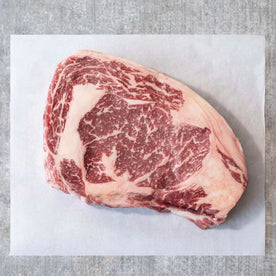
For consumers, that’s a problem, because a lot of the American Wagyu market quietly settles near the bottom of that range, and purveyors don’t offer transparency about their quality. But the Beef Marbling Scale (which measures the fat marbling and whose scores determine levels like USDA Prime) doesn’t lie. Most American Wagyu scores between a 4 and a 5—not much above USDA Prime, which scores at 3. Meanwhile, Miraflora Wagyu consistently scores between a 6 and an 8. Those scores are the result of a disciplined, science-first approach to genetics that starts with where Wagyu actually comes from: Japan.
Rhoades, one of the foremost Wagyu experts in the country, holds a PhD in meat science from Texas A&M and serves as the beef extension specialist for Colorado State University. He’s a scientist who has spent his career understanding this breed at the cellular level—its gene expressions, its fat composition, its unique ability to convert saturated fat into oleic acid, the same healthy fat found in olive oil. That’s why he’s our secret weapon: He produces some of the highest-marbled American Wagyu ever recorded, all on our ranch under our label.
Our herd, curated by Rhoades, includes Japanese Black and Red Akaushi cattle—two distinct Wagyu breeds with genetics directly traceable to Japan. Blacks are renowned for superior marbling. Reds are larger and bring remarkable depth of flavor. By working with both breeds, we're capturing the full genetic potential of what Japanese Wagyu can be.
Miraflora’s approach is deliberately scientific and uncompromisingly selective. We’re not just hoping for great outcomes—we’re engineering them through carefully matching genetic lines to the specific traits we’re looking for.
It's a process built on rigor, patience, and decades of accumulated knowledge. As Rhoades has said, reaching the genetic potential of these animals requires a fundamentally different mindset than conventional beef production: “You can’t push these animals and reach the genetic potential—this is where a lot of people go wrong.” That’s why we feed our cattle for at least 425 days—nearly three times the industry standard.
That’s what sets Miraflora Wagyu apart. We believe if you’re going to eat beef, it should be the best beef on the planet. We’ve spent years making sure that’s exactly what we offer.
More blog posts

Weeknight Wagyu Stroganoff
A pantry-friendly stroganoff from influencer Josh Franks that turns a pound of Miraflora sirloin into dinner in about 30 minutes.

Here’s What Not to Do With Wagyu
Eight cooking mistakes you might not even know you’re making.

Why We Sell Out
If you’ve visited our shop lately and found your favorite cut marked “sold out,” you're not alone.